
C++26 Reflection: Can the Compiler Finally Help Us Parse Configuration?
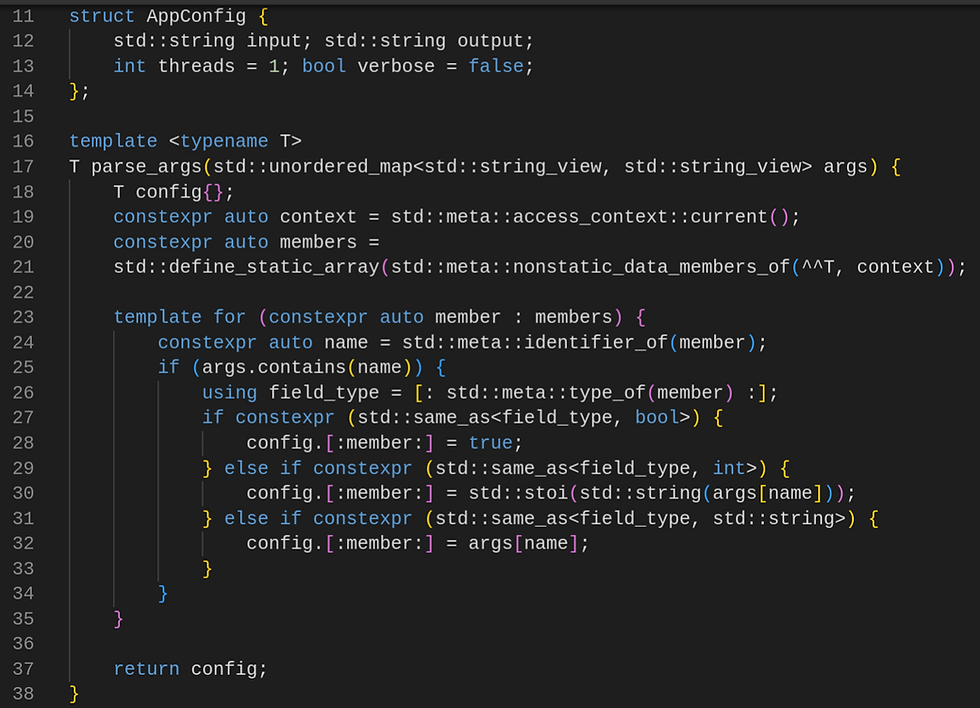
Hi C++ friends 👋
Today we continue exploring one of the most exciting features coming with C++26: static #reflection.
In previous posts, we looked at how reflection can help us build “magic enum” style utilities, and even how we can generate aggregate-like structures from text at compile time.
This time, let’s look at something much more practical.
And much more painful.
Reading configuration from command-line parameters.
And by “painful,” I mean the #boilerplate kind. 🙂
The Configuration Problem
Almost every application needs configuration.
Sometimes it is simple:
--host localhost --port 8080 --verbose true
Sometimes it becomes more complex:
--threads 8 --log-level debug --timeout 30 --enable-cache true
And sometimes, because software has a sense of humor, it becomes a complete configuration framework with validation, defaults, help messages, aliases, environment variable support, and 27 special cases.
In C++, we have many ways to deal with this.
We can parse the arguments manually.
We can use Boost.
We can use Google-style flags.
We can use custom libraries.
And, of course, we can build the classic “small internal parser” that starts as a 50-line utility and somehow becomes its own product.
The problem is not that these solutions are bad.
Many of them are very good.
The problem is that the configuration structure and the parsing logic are often separated.
We define the data in one place.
Then we define the parsing in another place.
Then we define the validation somewhere else.
Then we define the help message.
Then we rename one field and forget to update one of those places.
And then production reminds us that “small change” is a dangerous phrase.
The Python Feeling
You describe what you want, and the boring work is handled for you.
You say: this is the option, this is the type, this is the default, this is the help text.
The library does the rest.
In C++, we can absolutely build good APIs for this too, but we usually need more ceremony.
More duplication.
More templates.
More macros.
More code that exists only because the compiler knows the information, but we cannot easily ask it.
This is where C++26 #reflection becomes very interesting.
The Struct Is Already the Source of Truth
When we define a configuration structure, we already give the compiler a lot of information.
The compiler knows the field names.
It knows the field types.
It knows the shape of the data.
For example, if our application has fields like host, port, verbose, timeout, or log_level, the compiler already has this information during compilation.
The question is:
Can we use that information to generate the parsing logic?
With static reflection, the answer starts to become yes.
Instead of manually writing parsing code for every field, reflection allows us to inspect the configuration structure at compile time and generate code based on its members.
So conceptually, we can say:
For every field in this struct:
Get the field name.
Look for a matching command-line argument.
Convert the string value to the field type.
Assign it to the correct field.
The boring part becomes generated.
The runtime part becomes simple.
At runtime, we only need to take the command-line arguments, store them in something like an unordered_map, and let the generated code assign the values to the correct fields.
Why This Is Powerful
This may look like a small example, but the idea is very powerful.
We remove duplicated metadata.
We reduce boilerplate.
We make the struct the source of truth.
We avoid the classic bug:
“I renamed the field but forgot to update the parser.”
We also get closer to a style where the compiler helps us build infrastructure code instead of just checking whether we made a mistake.
And honestly, that feels like a big step.
For years, the compiler has mostly been the strict teacher standing in the corner saying:
“No.”
With reflection, it can also say:
“I already know this information. Want me to help generate the boring code?”
That is a much better relationship. 😉
Compile Time vs Runtime
One important point is that reflection itself happens at compile time.
We are not trying to inspect random objects dynamically at runtime like in some other languages.
The idea is different.
We use compile-time information to generate code.
Then, when the program runs, we execute normal C++ code.
This is one of the reasons I find this feature so interesting.
We can get better ergonomics without necessarily paying for runtime introspection.
The compiler does the heavy lifting before the program starts.
The application runs the generated logic.
That is exactly the kind of tradeoff C++ developers usually like.
We want abstraction.
But we also want control.
And we definitely want performance.
Because if it is not fast, someone on the internet will let us know. 🙂
This Is Not a Full Argument Parser
Of course, this example is not a production-ready argument parser.
A real library would need much more.
Defaults.
Required fields.
Validation.
Better error messages.
Help generation.
Aliases.
Boolean flags.
Nested configuration.
Environment variables.
Maybe config files too.
Maybe JSON, YAML, TOML.
And then, before we know it, we have created another “small internal parser” that became a product.
But this time, the foundation can be better.
Instead of duplicating the structure manually, we can build around reflection.
The configuration type can become the central source of truth.
Everything else can be derived from it.
Maybe It Is Time for a New Library
I think this is where C++26 reflection becomes more than a cool language feature.
It becomes a tool for building better libraries.
A modern C++ configuration library built around reflection could be really interesting.
You define a struct.
The library reflects over it.
It generates parsing logic.
It generates help text.
It validates types.
It reduces boilerplate.
And maybe, just maybe, it gives us a little bit of that Python argparse or click feeling, but in C++ style.
Strong types.
Compile-time generation.
Runtime performance.
And fewer places to forget to update.
Maybe it is time for a modern C++ argument/configuration library built around reflection.
Maybe I will write one. 🙂
Or maybe I will start writing one, call it reflect_args, spend three weekends bikeshedding the API, and then discover that naming things is still the hardest problem in computer science.
As always:
Keep learning.
Keep experimenting.
And stay tuned 🚀


